The question “Does baptism save us?” is often met with mixed answers in the religious world. Yet, when we turn to Scripture, particularly 1 Peter 3:18–22, the Apostle Peter presents a clear and compelling case. His words connect the act of baptism with the power of Jesus’s resurrection and with God’s consistent method of saving the obedient through water.
For Christ also suffered for sins once for all, the righteous for the unrighteous, so that He might bring you to God, having been put to death in the flesh, but made alive in the spirit; in which also He went and made proclamation to the spirits now in prison, who once were disobedient, when the patience of God kept waiting in the days of Noah, during the construction of the ark, in which a few, that is, eight persons, were brought safely through the water. Corresponding to that, baptism now saves you—not the removal of dirt from the flesh, but an appeal of a good conscience to God—through the resurrection of Jesus Christ.
Jesus Suffered for Our Salvation (v. 18)
Peter begins this section by reminding his readers that Jesus Himself suffered unjustly. This continues the thought from verse 17, where Peter encourages Christians not to fear suffering for doing good. Jesus, the “just” (singular) one, suffered for the “unjust” (plural) — meaning all of humanity. His crucifixion ended His earthly, physical life (“put to death in the flesh”), but His spirit remained alive, continuing to exist separate from His body until His resurrection. At the resurrection, His spirit was reunited with a glorified body, thus “made alive in the spirit.”
Jesus Preaches Obedience for Salvation (vv. 19–20)
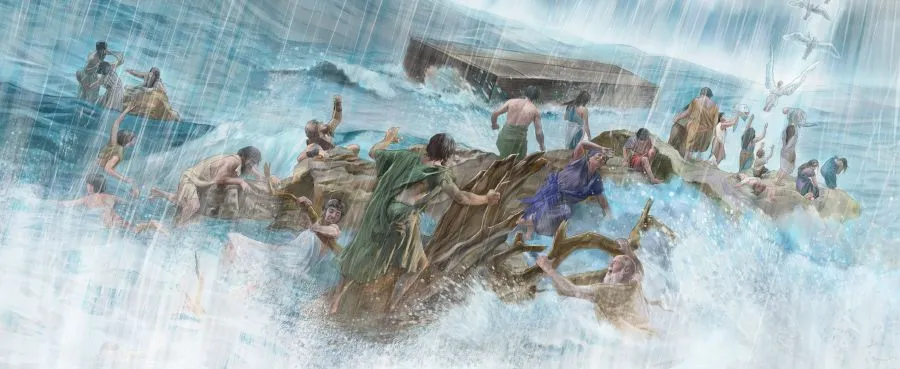
Verses 19 and 20 have long challenged readers, but the context helps us understand the bigger message. Peter refers to Jesus preaching to “spirits now in prison” — those who were disobedient during Noah’s time. The most reasonable understanding is that Jesus, through the Spirit, preached through Noah to the people of that generation. These people are now “in prison,” that is, awaiting judgment due to their disobedience. So, what’s the bigger message behind this difficult passage? God has always desired to save the lost, and He has worked through faithful servants like Noah to call disobedient people to repentance and obedience. Even in the Old Testament, the mission to save was ongoing.
This leads to Peter’s point about water: eight people were saved through water — not apart from it. While the floodwaters destroyed the sinful world, those inside the ark were saved by being lifted above it. God used water as a dividing line between the righteous and the wicked.
Baptism Now Saves You (v. 21)
Peter then draws a direct connection between the water of the flood and the water of baptism. “Corresponding to that,” he writes, “baptism now saves you.” The Greek word used is antitupos, meaning a counterpart or antitype. Just as the floodwater was an instrument of salvation for Noah’s family, baptism is now the means through which God saves people today. If one is not baptized, then he will not be saved – just like those not in the ark were not saved.
But Peter is careful to clarify that this is not a mere outward ritual. Baptism is not about “removal of dirt from the flesh” but is “an appeal to God for a good conscience.” It is an act of faith, calling upon God in obedience — just as seen in Acts 22:16, where Saul was told, “Arise and be baptized, and wash away your sins, calling on His name.” And, one “calls on the Lord” only after having obeyed what the Lord requires (cf. Matt 7:21-23).
Still, one might ask: how can immersion in water have such spiritual significance? Peter answers: “through the resurrection of Jesus Christ.” Baptism unites us with Jesus’ death, burial, and resurrection (cf. Romans 6:3–4). Without the resurrection, the water would be meaningless. But because Jesus conquered death, baptism becomes the point of contact with the saving power of the blood of Jesus Christ.
Conclusion
So, does baptism save us? According to Peter — yes, it does. Not because the water itself has power, but because God has chosen it as the moment of appeal, obedience, and union with the risen Christ. Baptism saves — not because the act itself is a work that earns our salvation, but because it is an act of faith. Through our obedience to God, He saves us, just as He saved Noah when Noah chose to obey God by building and entering the ark. Just as those outside the ark perished in the flood, those outside of Christ will not be saved. Baptism is not a human work but a divine command, rooted in faith and made effective by the resurrection of Jesus. It is where the sinner meets the Savior. As Jesus once said, “He who believes and is baptized shall be saved” (Mark 16:16). Peter simply echoes the same truth.